
Building the Workforce That Builds Louisiana
Since arriving at LSU in 2014, Jonathan Shi has enjoyed being part of the continuous growth and elevation of the university’s construction program.
Over the last decade, LSU has transformed its approach to construction education and research through strategic investments in faculty, facilities, and industry partnerships. Today, with the creation of the School of Construction and the future Construction & Advanced Manufacturing Building, the university is building on that momentum while preparing the next generation of leaders for one of Louisiana’s most important industries.
For Shi, the Art E. Favre Industrial Construction Chair, that growth has been remarkable to witness, largely because LSU’s partnership with industry has become one of the program’s defining strengths.
“In the last 12 years, oh, you can see the excitement,” he said. “I would say our industry has been probably playing the most proactive role in encouraging [LSU] to do more, to be at the forefront, to lead the future — and now we are one of the premier programs in the country.”
As a researcher, Shi focuses on solving practical challenges facing the construction sector, from enabling greater automation through robotics to using artificial intelligence to rapidly create highly accurate digital building models. Much of that work centers on helping industry professionals become more efficient and effective in their roles.
“Basically, I’m trying to make humans work more efficiently. Everybody has an assistant to help us do our jobs better,” Shi said.
While technology continues to advance, Shi was quick to emphasize that people remain at the center of the industry’s future.
“Technology, you can learn and adopt it easily, right? You get a new toy, you play with it, and you’ve learned it the next day. Talent is very different,” he said. “People are very different. You learn how to learn. You learn ‘how to fish.’”
That philosophy is reflected in the way LSU prepares students for careers in construction. Through coursework focused on productivity, operational performance, energy efficiency, and emerging technologies, students gain the skills needed to thrive in a rapidly evolving profession while remaining grounded in the fundamentals that employers value most.
And, according to Shi, the demand for those graduates will only continue to grow.
“I would say our industry has been probably playing the most proactive role in encouraging [LSU] to do more, to be at the forefront, to lead the future — and now we are one of the premier programs in the country.”
“Every year, the Baton Rouge Business Report will list the top 100 private companies in town. Of the top 10 businesses, six or
seven of them are all construction. The construction business is a very local business,
and that is the reason we have such a big enrollment in our program.”
Because many of Louisiana’s largest employers are construction-related companies, industry partners remain deeply invested in LSU’s success and actively engaged in developing future talent pipelines. According to Shi, those partnerships help fuel exceptional internship, employment, and placement opportunities for students.
“That is a very important factor for the students to come to the program,” he said. “That is why the employment and the placement for our students is so great — because there are so many positions.”
The new School of Construction and Construction & Advanced Manufacturing Building will mark the next stage in that evolution, expanding both the academic structure and physical space needed to sustain LSU’s continued growth.
A decade ago, the idea of establishing a standalone school seemed ambitious. Faculty numbers were smaller, research activity was limited, and the resources necessary to support a national-caliber program were still developing. Yet, visionary alumni and industry partners believed in what was possible.
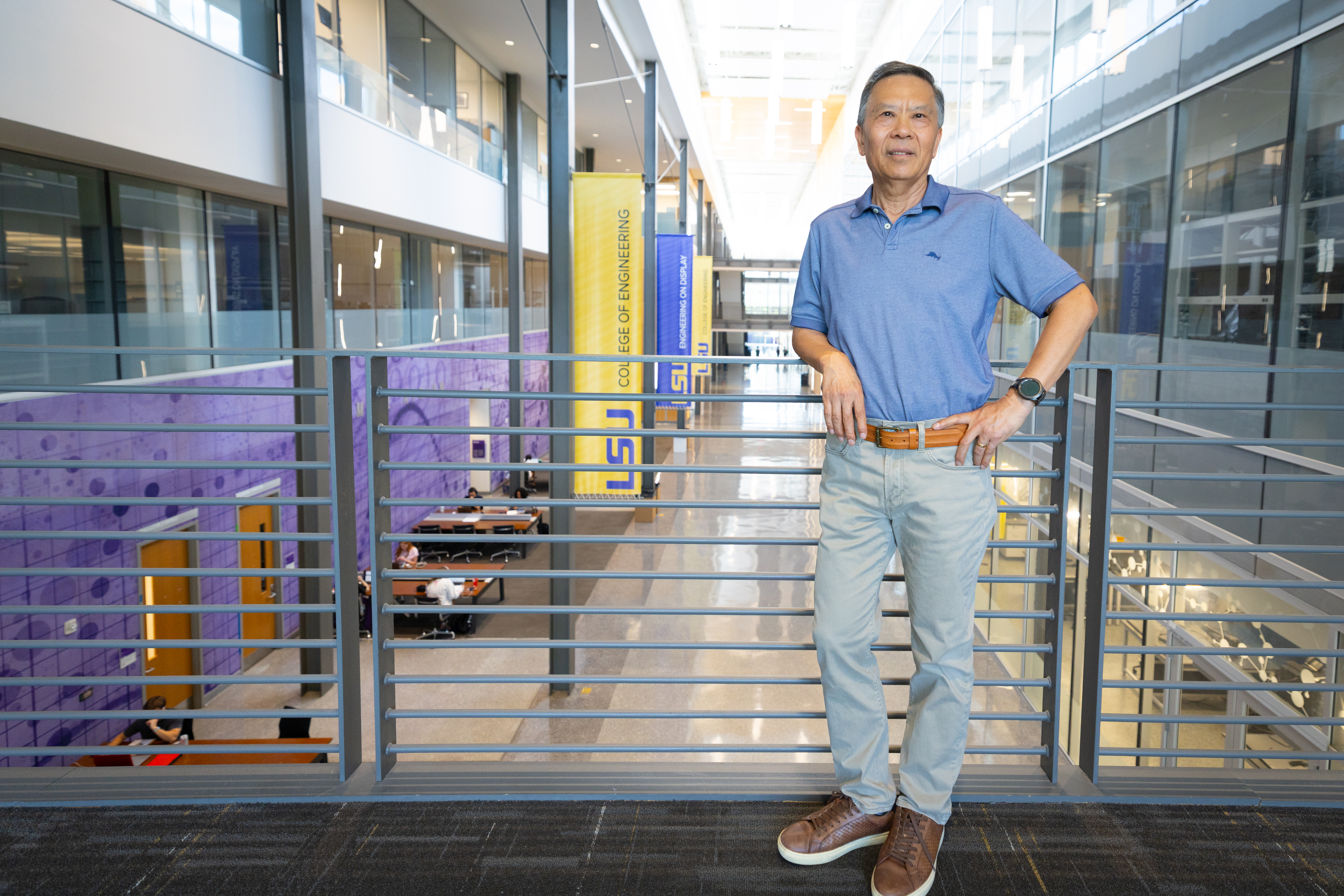
“Now in 12 years, all the names and all the parameters have changed significantly and have significantly improved,” Shi said. “All the top construction programs in the United States have their own building, and our building will be the biggest and the highest quality among [them].”
The building will become part of a larger transformation occurring across campus, joining recent investments such as the Our Lady of the Lake Health Interdisciplinary Science Building and other premier academic spaces that are reshaping LSU's academic footprint. For Shi, those investments are crucial for creating an environment that attracts talented students, faculty and industry partners while preparing Louisiana’s workforce for the future.
“By creating these endowments and professorships…[industry partners] are building up the foundation for developing high-level research,” Shi said. “Without my endowment, I would not be here. [It has] provided the resources to do some of the early-stage work. You have an initial idea that you would not know if it would work or not. You can really pursue some of the high-risk dreams and activities right away.”